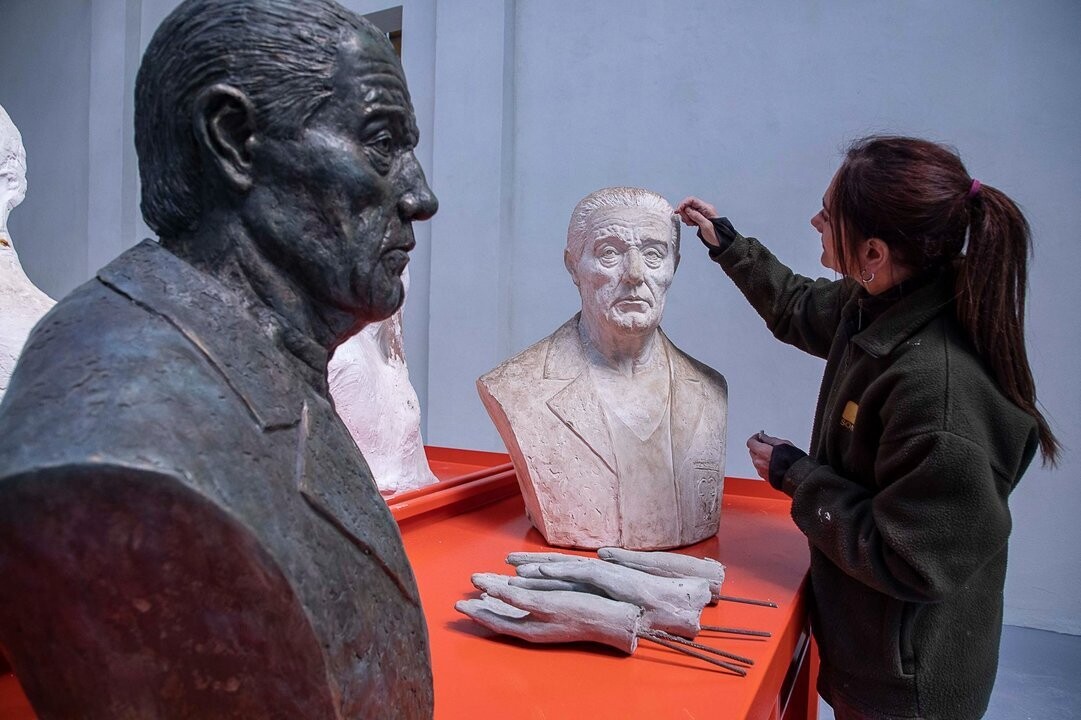
Buenos Aires, December 12 (NA) – The City of Buenos Aires paid homage to René Favaloro, one of Argentina's most beloved and respected physicians, with the first sculpture in his honor placed in a public space in the capital.
The work was installed in Plaza Paseo de la Vida, in the Caballito neighborhood, a green space that was named in his honor, according to the Argentine News Agency (Agencia Noticias Argentinas).
The bust was designed and created by one of the sculptors from MOA (Monumentos y Obras de Arte), the specialized workshop in charge of caring for the City's sculptural heritage.
"I feel that I was able to capture what had passed through my heart while I got to know and see that great man," affirmed Silvia, the author of the piece.
The green space where the bust was installed, located between Bacacay, Rojas, Nicolás Repetto and the tracks of the former Sarmiento Railway, was baptized in 2010 as "Paseo de la Vida: Dr. René Favaloro" through Law 3523.
The initiative was the idea of the sculptors from MOA, but the project took its definitive shape after a formal request from Commune 6, which proposed to equip Caballito with an intervention that would honor the famous Argentine physician.
"Favaloro is a symbol of values that transcend medicine: ethics, work, effort, and commitment to others. For the City, it is an honor that his figure becomes part of the public space as part of our collective memory," the statement signed by René Favaloro reads.
With this first sculptural homage, the City seeks to recognize a professional whose figure transcended medicine and became a symbol of vocation, professional commitment, and honesty, and whose career marked a before and after in world cardiovascular surgery.
René Gerónimo Favaloro was born in 1923 in a humble neighborhood of La Plata and was trained at the National University of that city, influenced by teachers with a strong humanistic imprint.
The standardization of the so-called bypass or myocardial revascularization surgery was the fundamental work of his career, which launched his prestige worldwide.
Love for his country led him to return in 1971 with the conviction of strengthening Argentine medicine, and in 1975 he founded the Favaloro Foundation, dedicated to assistance, research, and education.
"It is also a pride that the work was entirely done by MOA and its team of professionals," said Ignacio Baistrocchi, Minister of Public Space and Urban Hygiene.
The sculpture demanded four months of work and was in charge of Silvia Vera, an MOA sculptor, who meticulously researched photographs, interviews, and visual records of the physician's life to represent his features and presence with respect and precision.
The bust was made of cement, a material used in this type of outdoor work as it withstands the inclemencies of the weather.
"When they asked me to make the bust of Favaloro, I felt a great responsibility, I empathized a lot with his story and I understood the wonderful being he was. I felt grateful, that they trusted me to make this first homage in the City. His name became forever associated with the values he defended throughout his life: ethics, honesty, effort, commitment, and professional excellence."
He promoted the creation of the Favaloro University and developed multiple prevention programs and studies for the detection of diseases.
Right after graduating, he worked for 12 years as a rural doctor in Jacinto Arauz, La Pampa, where — together with his brother, also a doctor — he created a health center, drastically reduced infant mortality, infections in childbirth, and malnutrition, and organized a blood bank.
In 1962, he traveled to the United States to specialize at the Cleveland Clinic. At that time, his full name could not be formally assigned because ten years had not passed since his death; therefore, the name "Paseo de la Vida" was established and the designation "Dr." was left in reserve.
In 1967, he began to think about the possibility of using the saphenous vein in coronary surgery.
He received dozens of international awards and distinctions.